
LPPSA House Contractor in Selangor, Kuala Lumpur & Putrajaya
A civil servant who already owns land and wants to build with LPPSA financing (type 2)? This page explains what LPPSA asks of the contractor, how staged payments reach the contractor, and what RumahHQ, a CIDB-registered Grade G4 contractor, provides.
- LPPSA rate
- 4.00%
- fixed, reducing balance
- Financing limit
- RM1,000,000
- Contractor
- CIDB G4
- No. 0120260318-SL169289
- Released in stages
- Up to 95%
- on JPPH progress reports
8 min read · Checked
Share on WhatsAppShort answer
- LPPSA type 2 finances the construction cost on your own land at a fixed 4.00% (up to RM750,000), and the contractor must be CIDB-registered in construction.
- The money does not come to you: LPPSA releases it in stages to the contractor or the stakeholder lawyer, against JPPH progress reports up to 95% complete. The last 5% follows when LPPSA receives the CF or a copy of the CCC, or six months after the 95% payment, whichever comes first.
- You settle first only the difference (wang beza) if the contract price is above the amount approved, plus the plan and site preparation costs that LPPSA does not finance.
- We are CIDB-registered, Grade G4, and we prepare the council-approved plans, the building agreement (or its draft) and a copy of our CIDB certificate for your application.
- LPPSA alone decides your financing. We cannot guarantee approval.
What LPPSA asks of your contractor
These are the contractor-facing conditions in LPPSA's type 2 guidelines and checklist. Check that any contractor you sign with can meet every one of them.
- CIDB registration in construction
- LPPSA wants you to make sure the contractor is CIDB-registered in construction before you apply. Check the number yourself in CIDB's public contractor search.
- Approved plans that do not change
- The building plans must be approved by the council (PBT) or the District Office and still valid. LPPSA does not allow amendments to the plans once financing is approved, and its checklist warns this affects the release of progress payments, so settle the design, rooms and size first.
- A complete building agreement
- LPPSA accepts the agreement or its draft, as long as it states the property type, lot number, title number and price. What is financed is the construction cost in the agreement's payment schedule.
- A letter of undertaking (LU)
- The contractor gives a letter of undertaking to refund all payments if the build is abandoned for any reason.
- Progress claims that can be inspected
- Each claim goes to JPPH with a copy to LPPSA, and a JPPH officer inspects the site first. The first claim needs the Property Lot Certificate form and a certificate from a registered professional surveyor; the 95% claim needs the key handover letter and the electricity and water meter deposit receipts.
How staged payments reach the contractor
LPPSA does not pay the contractor on a calendar. It pays against inspected progress:
- 1 A stage of work is finished on site.
- 2 The contractor sends a progress claim to JPPH, with a copy to LPPSA, and a JPPH officer inspects the site first.
- 3 LPPSA releases the money to the contractor or the stakeholder lawyer, not to you.
- 4 The cycle repeats until the house is 95% complete.
- 5 The last 5% is paid when LPPSA receives the CF or a copy of the CCC, or six months after the 95% payment, whichever comes first.
What this means for you
- You do not hand over cash at each stage. The exception is the difference (wang beza): LPPSA approves the lowest of the contract price, the JPPH valuation, the amount you applied for and your maximum eligibility, and you settle any gap first, before LPPSA releases anything.
- LPPSA does not finance the cost of preparing the plans or the site, so budget for both yourself.
- Salary deductions begin in the 25th month from the approval date, or after the 95% payment is released, whichever is earlier, even if the house is not finished.
- Our own reference payment schedule and LPPSA's release rules do not use the same percentages. With LPPSA, LPPSA's rules decide when its money moves, so ask any contractor how its contract lines up with them. See the staged payment schedule.
What RumahHQ provides
- CIDB registration, Grade G4. The full certificate is shown below, with a link to CIDB's own register.
- Plans and council approval. We prepare the architectural and engineering plans and handle the council submission through to the CCC, at a fixed RM45,000, not a percentage.
- The building agreement (or its draft) and a copy of our CIDB certificate, ready for your LPPSA application.
- Progress claim documents in the format LPPSA expects. That is what our panel status means; it does not mean an approval is guaranteed.
- Payment tied to finished work. Every stage is verified before it is claimed.
- 12-month warranty after handover. What is covered and what is not.
- One rate, whichever way you finance. There is no charge based on how you pay: our rate is the same for LPPSA, a bank, EPF or cash.
Our status as a registered LPPSA panel contractor is not a guarantee of approval, and LPPSA is the one that decides your financing. Eligibility, rates and the full process.
We are a registered LPPSA panel contractor



Golden Sharp Innovation (IP0580950-X) is a registered panel contractor with the institutions above. Panel status means our credentials as a contractor have been assessed, and our progress-claim documents follow the format these institutions expect — it is not a guarantee that your financing will be approved, and not an endorsement of our services by them. Approval and terms are determined entirely by LPPSA or the bank concerned. Logos and trademarks are the property of their respective owners.
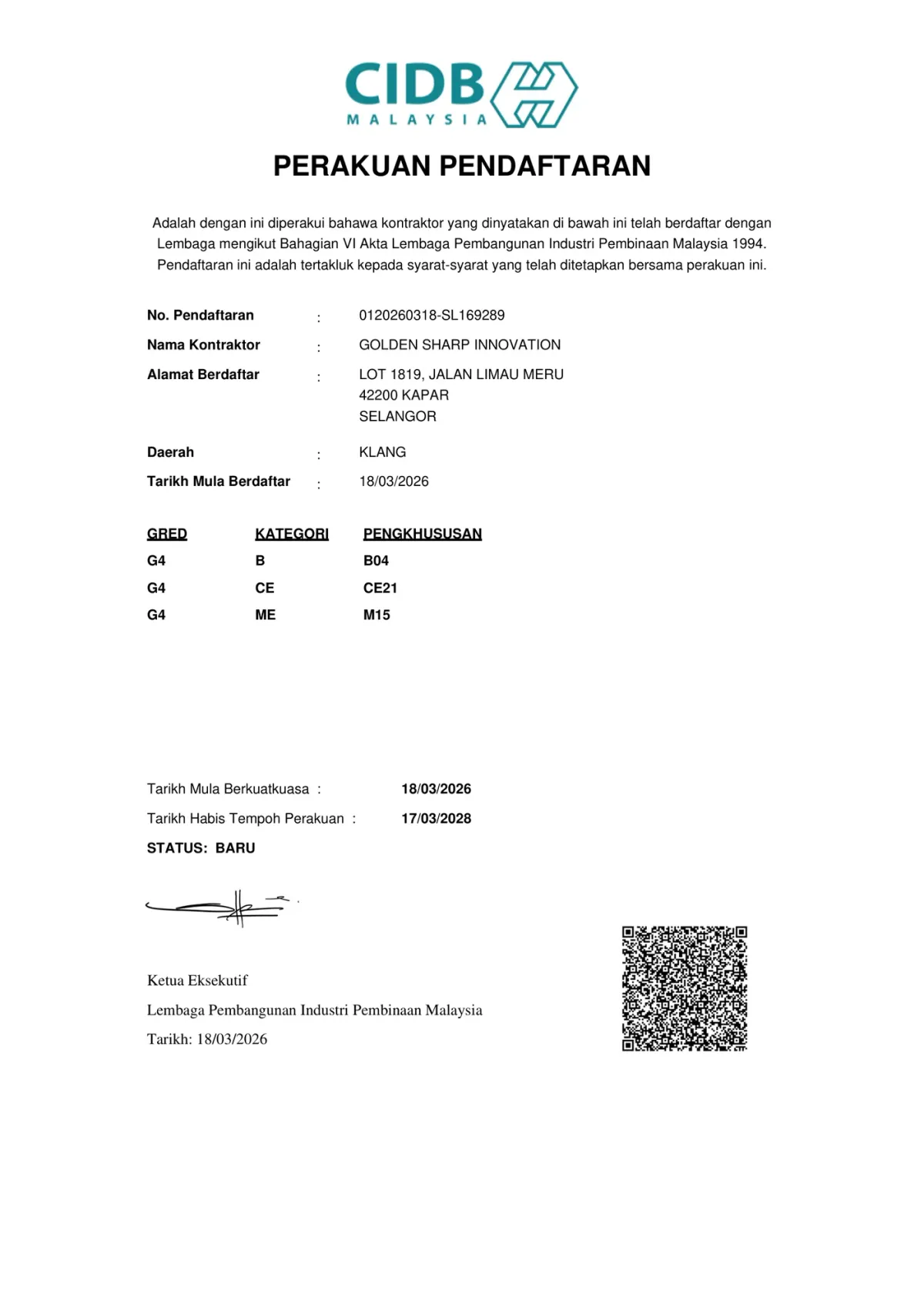 View the full certificate
Verified registration
CIDB-registered, Grade G4
Golden Sharp Innovation is registered with the Construction Industry Development Board (CIDB) Malaysia. This is our certificate, in full. Do not take our word for it: check the number on CIDB's own register, or scan the QR code on the certificate.
- Registration no.
- 0120260318-SL169289
- Valid until
- 17/03/2028
- Grade · Categories
- G4 Building (B04) G4 Civil Engineering (CE21) G4 Mechanical & Electrical (M15)
Your checklist: steps in the right order, and who brings which document
The steps
- 1 Check your estimated LPPSA eligibility.
- 2 Make sure your land is clear of blockers. LPPSA needs a single lot with an individual title, free of any charge.
- 3 Choose a design and get a formal quotation from us (free).
- 4 We prepare the plans and handle the council submission.
- 5 Sign the building agreement (or its draft) with us, and apply for the JPPH valuation.
- 6 Submit your LPPSA application through your Head of Department, with the approved plans and the building agreement.
- 7 Construction begins, and LPPSA pays against inspected progress claims.
The documents
From us
- The plans approved by the council or District Office, with the approval letter
- The building agreement, or its draft
- A copy of our CIDB registration certificate
From you
- The LPPSA application form, signed by you and your Head of Department
- Your identity card (and your spouse's, for a joint application)
- Your latest three months' payslips, certified by your Head of Department
- The Head of Department confirmation letter (original), in LPPSA's format
- An official or private title search made within the last 12 months
- Proof that JPPH has received the valuation form
LPPSA's own checklist warns that an incomplete application delays the review. The full list, and the items most often missed, are on the LPPSA financing page.
See our work first
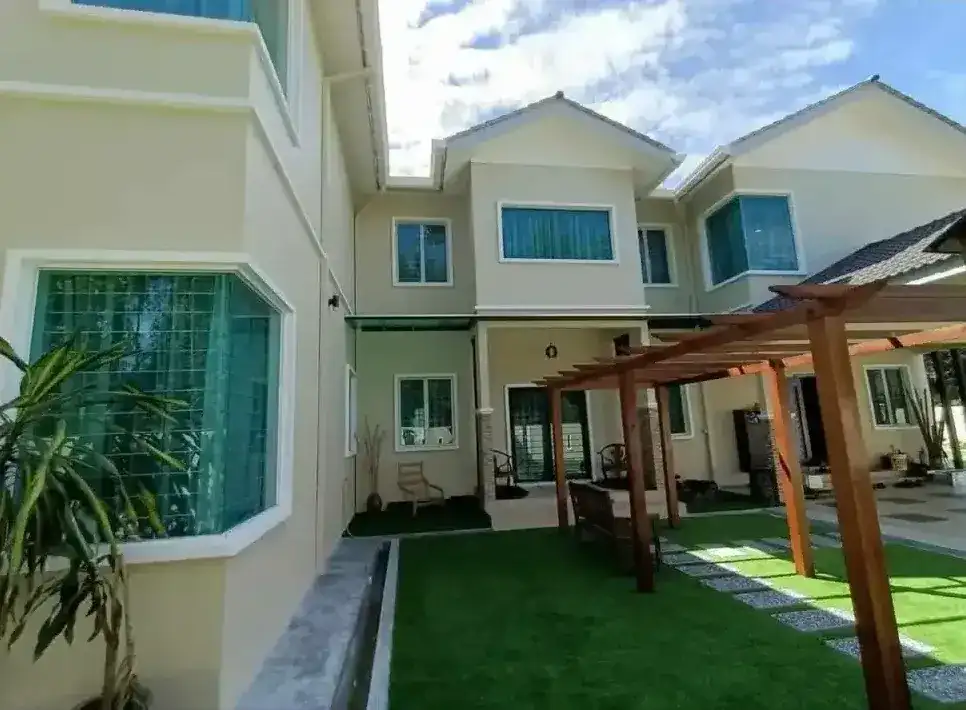
Real projects, photographed on our own sites:
Frequently asked
Is RumahHQ an LPPSA contractor?
Who pays the contractor while the house is being built?
Can I pay the contractor in cash, or into a personal account?
Does the contractor charge more if I use LPPSA?
Can I change contractor after LPPSA has approved my financing?
When do my salary deductions start?
Check your LPPSA eligibility, then get your quotation
One minute for the estimate: the amount, instalment, tenure and which rule caps you. Then tell us where your land is, and we give you a formal quotation. Free and with no obligation.