How to Build a House on Your Own Land: Complete Guide
How to build a house on your own land in Malaysia, from the land check and financing to council approval, payment stages, construction, CCC and warranty.
Share on WhatsApp
How to build a house on your own land starts with checking the land, not choosing a design. After that the order is fixed: choose a financing route, finish the design and quotation, get council (PBT) approval, sign the contract, build against staged payments, hand over and obtain the CCC, then the warranty period begins.
This article explains each stage: what happens, who does it, which documents are needed and when money moves. It is written for landowners in Selangor, Kuala Lumpur and Putrajaya who want to understand the whole journey before they sign anything. Every stage has a full page on this site; this article is the map that connects them.
In short
- There are 8 stages. The typical total is 12–18 months, because some stages run in parallel.
- Check the land first. Its category, title, road access and site conditions can stop a project before a design is chosen.
- Choose a financing route before choosing a design. Our price is the same for LPPSA, a bank, EPF and cash.
- Do not start site work before the council has approved the plans. Plans must be submitted by a registered professional, not by the landowner.
- Payment is tied to verified work, in 7 stages: a 5% confirmation deposit at the start and a final 5% at handover.
- After handover come the CCC and a 12-month warranty.
The big picture: eight stages
Our workflow has 12 steps in four phases. Here they are grouped into eight stages so the journey is easier to follow. Figure 1 shows the order, and Table 1 shows the typical duration of each step inside each stage.
The durations in the table are typical ranges, not promises, and council approval varies most from one council to another. Some steps run in parallel, so the overall duration is shorter than the sum of all the steps. The two things that most often slow a project are council approval and financing documents, and both can be started earlier than most people think.
Table 1. Stages, workflow steps and typical durations.
| Stage | Steps in the workflow | Typical duration |
|---|---|---|
| 1. Check the land | Initial Consultation; Land Check | 1–3 days; 3–7 days |
| 2. Choose financing | Check eligibility first, then Financing Documents | 1–3 weeks for the documents |
| 3. Design and quotation | Concept Plan & 3D; Quotation | 1–2 weeks; 3–7 days |
| 4. Council approval | Submission to Council; Local Authority Approval | 2–4 weeks; 3–4 months |
| 5. Contract and payment schedule | Contract and staged payment terms | Before construction starts |
| 6. Construction | Construction | 5–6 months |
| 7. Handover and CCC | Quality Inspection; Key Handover; CCC Certificate | 1–2 weeks; 1 day; 2–4 weeks |
| 8. Warranty | Warranty | 12 months |
Who does what
One reason people get stuck is not knowing who is meant to move next. Figure 2 shows who is involved at each stage.
- You provide the land and financing documents, set the space needs and budget, approve the plans and quotation, and take part in the joint inspection before handover.
- RumahHQ runs the consultation, land check, design, quotation, construction and warranty, and follows up the council approval on your behalf.
- The PSP is the registered architect or engineer who submits the plans to the council, supervises construction and issues the CCC. A landowner cannot sign the plans personally.
- The council (PBT) reviews and approves the plans, and inspects during construction.
- The lender (LPPSA or a bank) assesses your application and releases staged financing directly to the contractor, against verified work.
Stage 1: Check the land first
Many dreams of building a house stall not because of money or design, but because the title is still agricultural, an inheritance has not been divided, or the lot has no registered road access. That is why the land check comes first, before you spend anything on drawings.
Four things stop projects:
- Land category and express conditions. On agricultural land, the National Land Code allows only an owner’s house, on no more than one fifth of the lot or 2 hectares, whichever is smaller, and only if the express conditions do not forbid it. Beyond that, the land must first be converted. The council and the lender still make their own decisions.
- Title. The land is the security. If the name on the title is not the applicant’s, or an inheritance is undivided, no lender will approve construction financing.
- Road access. Without registered road access, plans are not approved and concrete lorries cannot reach the site.
- Site conditions. Slopes, soft ground or a site that holds water need extra earthworks and foundations. That is a real cost, and it is not inside the ordinary per-square-foot rate.
Do the official search first, before any payment. It shows the current owner, charges and caveats. Our Land Check tool asks seven questions and takes a minute. For a first estimate it assumes roughly 45% of the lot area can become the house footprint, and it flags lots smaller than 1,800 square feet. That is a planning figure for judging designs, not a council approval.
If the land is inherited or still agricultural
Land in a parent’s name, undivided inherited land and agricultural land are not automatically “no”, but they need sorting out first and that can take months. Do not wait for a conversion to finish before checking your financing eligibility: both can run at the same time. The first step for each case is in our article on agricultural and inherited land and on the Start here page.
Stage 2: Choose a financing route
Choose the route before you choose a design. The most expensive mistake in this process is falling in love with one plan and then finding that your approval is lower than its cost. Check your eligibility first; the tool is free and needs no sign-up.
Table 2 compares the four routes. Whichever you choose, our price is the same: the per-square-foot rate does not change with how you finance.
Table 2. The four financing routes for building a house.
| Route | Who it is for | Key figures | Worth knowing |
|---|---|---|---|
| LPPSA | Civil servants | 4.00% fixed up to RM750,000, 4.50% on the balance above it; limit RM1,000,000 | No margin. LPPSA approves the lowest of four figures, and you pay the difference (wang beza) first |
| Bank loan | Private sector and self-employed | Estimated 4.30% floating, as at 2026-09-23 | DSR and margin decide the amount, not the advertised rate. Ask for the margin basis in writing |
| EPF Akaun Sejahtera | EPF members who meet the conditions | A withdrawal, not a loan | Best for covering the difference, not the whole house. EPF pays into your own bank account |
| Cash | Your own funds | No interest, no charge on the property | Same payment schedule and council approval. Usually one to two months shorter |
A few things that are often overlooked:
- LPPSA approves the lowest of four figures: the construction contract price, the JPPH valuation, the amount you apply for and your maximum eligibility. If that figure is below the contract price, you pay the difference (wang beza) first. The RM1,000,000 limit and when applications open are explained in our LPPSA limit article.
- A bank charges interest only on the amount released during construction. How banks work out DSR and margin is in our bank loan article.
- EPF is not financing. The money is paid into your bank account, and you then pay the progress claims yourself. The withdrawal conditions are on the EPF page.
- Your land can help. Under the Zero Deposit scheme no cash deposit is paid to the contractor, but you still bear third-party costs such as stamp duty, legal fees and valuation.
- Civil servants can choose a bank too. Some civil servants qualify for both, and the answer is not always LPPSA. LPPSA or a bank? compares the two with real figures.
In our workflow the financing documents are prepared after the plans are approved, because LPPSA and banks ask for the approved building plan before releasing construction financing. The eligibility check, however, is done early. Before you apply, avoid taking on any new loan, even a small one: it raises your DSR at the worst possible time. Our LPPSA eligibility guide shows how to work it out yourself.
Stage 3: Design and quotation
You can choose from 62 ready plans with 3D, full drawings and a cost estimate, modify one of them, or ask us to draw a new plan to suit the shape of your land. The consultation, concept plan, 3D views and quotation are all free and carry no commitment. If you are still choosing, our guide to choosing a single-storey bungalow plan helps you narrow down by land size and number of bedrooms.
Our quotation runs from A to Z up to handover. Before that, the cost calculator gives a first estimate. The per-square-foot rate is a range, because the real rate depends on the design and specification, and our QS team sets it after studying the construction drawings.
Table 3. Package rates per square foot, structure and finishes only.
| Package | 1-storey house | 2-storey house |
|---|---|---|
| Gold | RM210–240 psf | RM220–250 psf |
| Silver | RM200–220 psf | RM210–230 psf |
Those rates cover structure and finishes. Two separate fixed costs are added on top: council approval through to the CCC at RM45,000, and permanent electricity and water meters at RM5,500. For example, a single-storey 1,800 square foot house, Gold package, with both fixed costs comes to RM428,500 to RM482,500. Land price, unusual earthworks, fencing, landscaping, air conditioning and furniture are not included; the full list and the reasons are in hidden costs of building a house, and the cost to build a house on your own land in 2026 gives the full breakdown. What each package covers is on the packages page.
When you compare quotations from several contractors, make sure they are like for like. Comparing unequal quotations and vague specifications is a common risk at this stage, so check the specification included before you judge the price.
Stage 4: Council approval
Many people treat council approval as administration that can be done later. It cannot. The approved building plan is the document LPPSA and banks ask for before releasing construction financing, so it sits on your project’s critical path. The typical duration is 3–4 months.
What you should know:
- Plans must be signed by a registered professional. A registered architect or engineer submits the architectural and structural plans. A landowner cannot submit or sign them personally.
- It is a set of approvals, not one. The council wants planning permission, engineering plans and the building plan in order, and its technical departments may ask for amendments.
- Our fixed cost of RM45,000 covers the plans by registered professionals, council fees, submission and follow-up until the CCC is issued.
- Do not start site work before the plans are approved. A structure that does not comply with the approved plans has to be altered or demolished, and that cost cannot be recovered.
- The first four documents are your responsibility: the original title or a certified copy, the latest quit rent receipt with no arrears, the site or lot plan from the Land Office, and proof that the land category and express conditions allow a residence.
Table 4 lists the documents usually asked for at each stage, so you can prepare them early.
Table 4. Documents by stage.
| Stage | Documents |
|---|---|
| Land check | Identity card; land title; site or lot plan; latest quit rent receipt |
| Financing | Latest three payslips; EPF and bank statements; financing forms; CCRIS or CTOS report |
| Design and quotation | List of space and room requirements; design reference images; package choice and specification |
| Council approval | Architectural and structural plans; council application form; processing fee |
| Contract and construction | Contract and staged payment terms; work schedule |
| Handover and CCC | Complete Forms G1 to G21; subcontractors’ completion certificates; defects list; handover form; equipment manuals and supplier warranties |
The full rules, who may submit plans and the actual council fees are on the council approval page.
Stage 5: Contract and payment schedule
The question people ask most, and the industry answers least clearly, is when the money goes out. Our reference schedule ties every payment to a stage of work that can be seen and verified, not to a calendar date and not to a large advance. Figure 3 shows the whole schedule, and Table 5 shows what must be finished before each claim, using a construction cost of RM450,000 as the example.
Table 5. Reference payment schedule, with a construction cost of RM450,000 as the example.
| Payment stage | Must be finished before the claim | % | Example RM450,000 |
|---|---|---|---|
| 1. Confirmation deposit | Contract signed, approved plans received | 5% | RM22,500 |
| 2. Site work and foundations | Foundations verified, the relevant Form G signed | 15% | RM67,500 |
| 3. Ground-floor structure | Structure verified by the engineer | 20% | RM90,000 |
| 4. Walls and roof | Roof complete, house watertight | 20% | RM90,000 |
| 5. M&E and plastering | Plumbing and wiring tests passed | 15% | RM67,500 |
| 6. Finishes | All finishes installed | 20% | RM90,000 |
| 7. Handover and final payment | Defects list cleared, keys handed over | 5% | RM22,500 |
| Total | 100% | RM450,000 |
This schedule is a reference, not a contract term. The contract you sign is what binds, and the final schedule and terms are set out in it. As explained on our payment schedule page, you are not buying from a housing developer, so there is no statutory payment schedule for your contract: the contract itself sets it. The comparison with Schedule G and the standard contract forms is on the payment schedule page.
How progress claims work
- A stage of work is completed on site.
- An engineer or supervisor verifies that the work complies with the approved plans and signs the stage certificate.
- We prepare the progress claim in the format the lender expects.
- The lender checks it, then pays us directly.
- You receive a record of every disbursement.
With LPPSA or a bank, you do not pay us directly during construction, apart from any difference (wang beza). If you pay in cash, you pay to the same schedule, and you have to set up your own controls because nobody else checks each payment.
Warning signs before you sign
- A large payment before work starts. Our confirmation deposit is only 5%.
- A claim with no certificate behind it. Payment should follow a professional’s certificate, not the contractor’s invoice alone.
- Payment in cash or to a personal account. Pay the company account named in the contract and ask for a receipt.
- An unregistered contractor. Check the contractor’s CIDB number in CIDB’s public search before paying anything.
- Extra work agreed only by word of mouth. Every variation order should be in writing, with the price agreed before the work is done.
Stage 6: Construction
Site work starts once the plans are approved and the contract is signed, and it typically takes 5–6 months. The order matches the payment stages: site work and foundations, structure, walls and roof, M&E and plastering, then finishes.
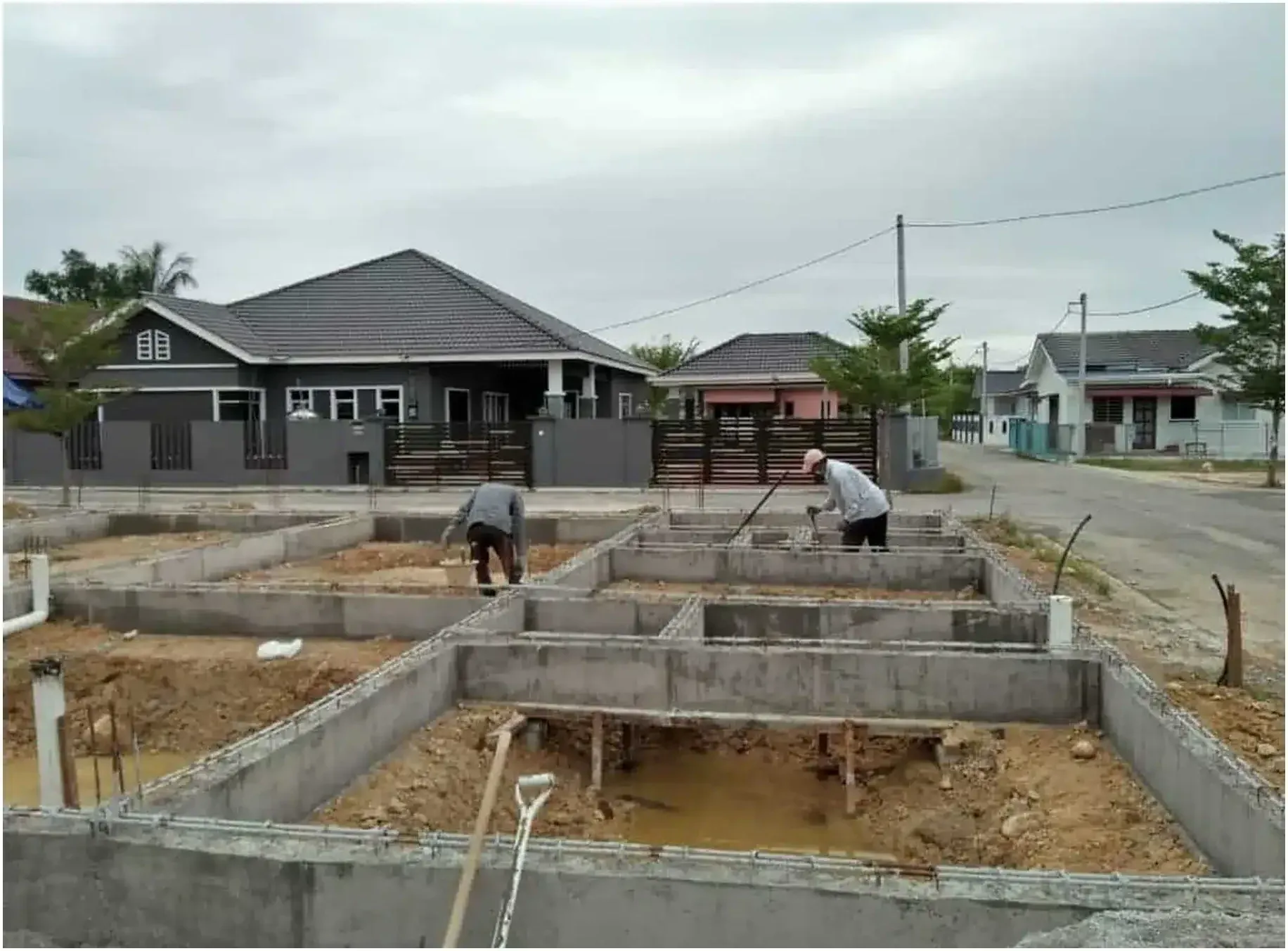
Foundation stage on one RumahHQ site: soil being levelled between finished ground beams.
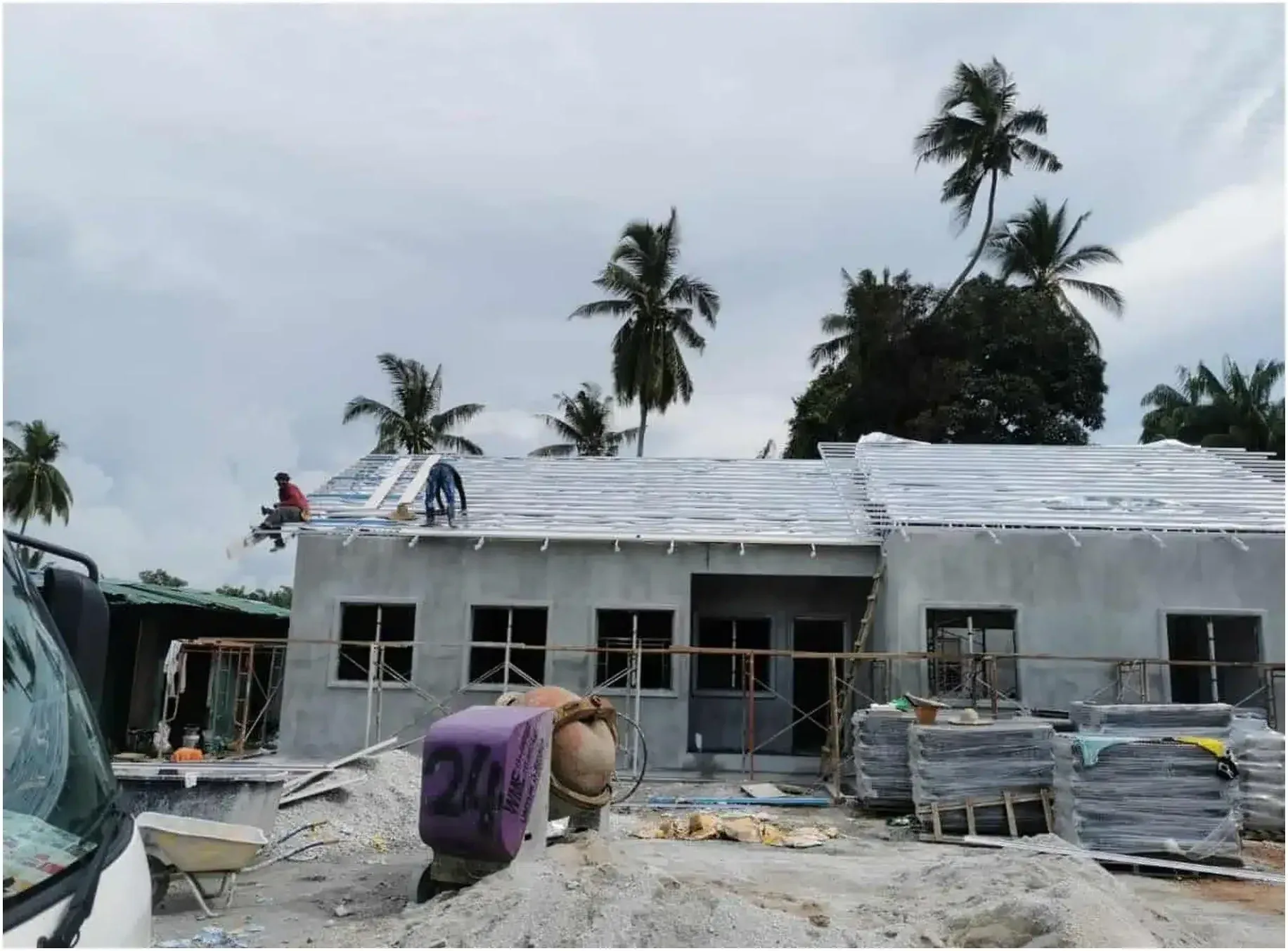
Roof stage on another site: waterproofing and battens go on before the tiles.
What you can do during construction:
- Visit the site. CIDB’s homeowner guide suggests visiting at least once a week, or when important work is being done. Arrange it with the site supervisor, and wear a hard hat and safety shoes.
- Avoid frequent changes. A change of scope (variation order) is added as a separate item with its own price. If it is needed, agree it in writing with the price first, before the work is done.
- Pay to the agreed schedule, and keep every receipt and stage certificate.
- Collect the Form G certificates throughout construction. Stage certificates are gathered while work is under way, not hunted down at the end, because a subcontractor who has left the site is hard to reach for one signature.
Common risks at this stage are prolonged bad weather, rising material prices and changes of scope. Guidance on visiting the site safely is on the workflow page.
Stage 7: Handover and CCC
When the finishes are done, you and our quality supervisor walk through the whole house together in a joint inspection. Every defect is recorded in writing with photos, and all of them are fixed before handover. The final 5% is paid at handover, once the defects list is cleared. You then receive the keys together with the handover form, the equipment manuals and the supplier warranties.
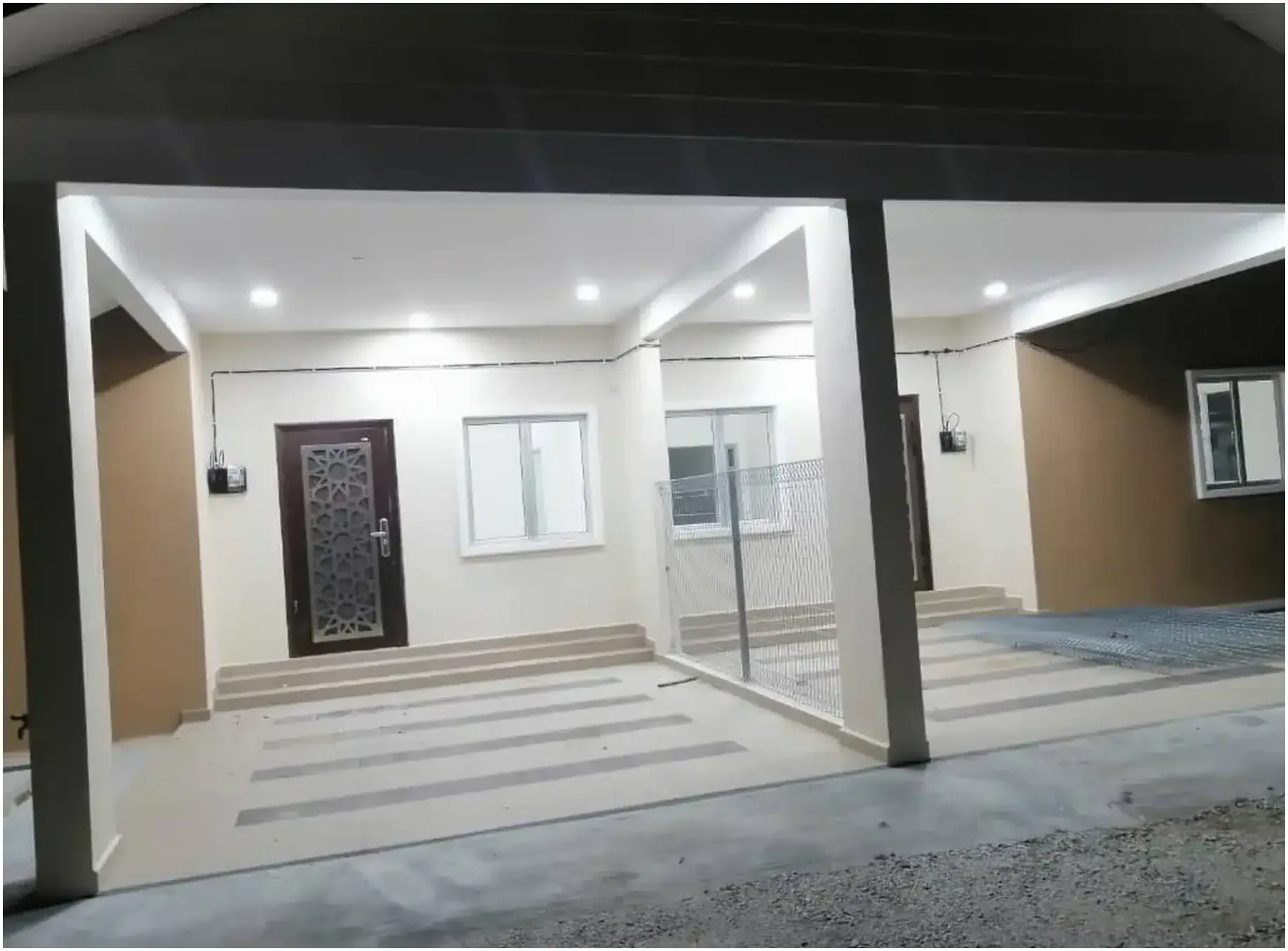
The carport of a completed RumahHQ house, lit at night.
The CCC (Certificate of Completion and Compliance) is issued by the PSP, the architect or engineer who submitted the plans, typically 2–4 weeks after completion. It confirms the house was built to the approved plans and is safe to occupy. The CCC decides when you may legally move in, connect permanent utilities and mortgage the house, so a “finished” house without a CCC is not finished in any way that matters. For LPPSA financing, the rules for releasing the final portion also refer to the CCC; the details are on the payment schedule page.
Stage 8: The 12-month warranty
The warranty runs for 12 months from the day of handover, with no inspection fee. It covers structural defects, roof and pipe leaks, electrical work, wet finishes, and doors, windows and cabinets. Normal wear and tear, later alterations, failure to maintain and branded equipment that has its own manufacturer’s warranty are excluded.
To make a claim, send photos and a short description by WhatsApp; repairs within the warranty scope are made at no charge. Report early, even if it is small: a hairline crack reported in the third month is a small repair. Your legal rights do not end with the warranty. The full scope is on the warranty page.
Five costly mistakes
- Choosing a design before checking the land and your loan eligibility. The design you like may be bigger than your land or your financing allows.
- Building first and applying for approval later. A structure that does not comply with the approved plans has to be altered or demolished, and it affects the CCC and financing.
- Plans without a registered professional’s signature. They look cheaper up front and turn into complete rework later.
- Paying a lot before work starts. Tie payment to verified work, not to dates.
- Not collecting Form G certificates and records throughout construction. Complete records speed up the CCC and protect you if there is a dispute.
Frequently asked questions
How long does it take to build a house on your own land? Typically 12–18 months in total, but that is a range, not a promise. Council approval (3–4 months) and construction (5–6 months) are the two longest periods, and some steps run in parallel. Paying in cash usually shortens the schedule by one to two months because there is no financing workflow.
Can I build a house without a loan? Yes. You pay to the same staged schedule, and council approval, the CCC and the quality inspection still apply because they are legal requirements or protections for you. Read building with cash.
Who manages the council approval? We do. Registered architects and engineers submit the plans, we follow up with the council until approval, and we manage the CCC when the house is complete. The fixed cost is RM45,000.
When do I start paying? After the contract is signed and the approved plans are received, with a confirmation deposit of 5%. If you are financed by LPPSA or a bank, the lender pays us directly against verified claims, and you only settle the difference (wang beza) first, if there is one.
Can I build on agricultural or inherited land? Sometimes, once the land has been sorted out. An owner’s house is allowed on agricultural land within set limits unless the express conditions forbid it, and inherited land that has not been divided cannot be charged to a lender. Start with the land check.
Which documents should I prepare first? The land title, the latest quit rent receipt and your identity card. Table 4 lists the rest by stage.
Next steps
- Check your land in one minute
- Check your loan eligibility before choosing a design
- Work out your cost with package, council approval and meters shown separately
- Browse 62 house plans and pick one that suits your land
- Read the 12-step workflow with documents, risks and tips for each step
- Contact our team for a site visit and a formal quotation, free and without obligation
Figures in this article are the rates, fixed costs and reference schedule in force on 23 September 2026; cost estimates are not a formal quotation, and the final payment schedule is set in your contract. Approval of financing and of plans is decided by LPPSA, the bank and the council concerned, not by us. Land price is not included.
Work out your own figures
The same rates used in this article, with your own numbers. Free and with no registration.
Rates effective 2026-09-23.
The guides behind this article
Read next
-
Building on Agricultural or Inherited Land: Check This First
Agricultural land, an unsettled estate, joint title or no road? How to read your title, convert land use, and the right order before building on your own land.
-
Building a House with a Bank Loan: DSR, Margin & Deposit
How banks assess a loan to build on your own land: DSR, margin, the real deposit and staged disbursement, with a full worked example.